How We Got Here.
Our firm has certain standards below which I’m not prepared to stoop.
Personal values should be judged not only by how a person describes themselves, but by what they continue to do, and refuse to do, when other choices are available.
Those choices may be reflected in corporate management, contracts and the treatment of personal information, or in the lighting, noise, sound and editing of a video. These apparently separate disciplines may rest on the same value judgments.
This living document records those judgments, traces their origins and explains how they become practical standards.
It is not a description of who I am, but a record of how I make choices.
Part I. Authenticity · 1.1 Preserve native camera noise
Digital imaging makes it increasingly possible to remove imperfections, but removing imperfections is not equivalent to improving image quality. Camera noise originates in the imaging system rather than in the subject itself. Excessive noise reduction can remove genuine detail, and temporal processing can introduce motion artifacts. [10]
I do not judge image quality primarily by cleanliness. I prefer retaining some native noise to sacrificing skin texture, surfaces and environmental detail for a superficially perfect image. Necessary restoration is welcome; restoration is not an end in itself.
Value: authenticity before superficial perfection.

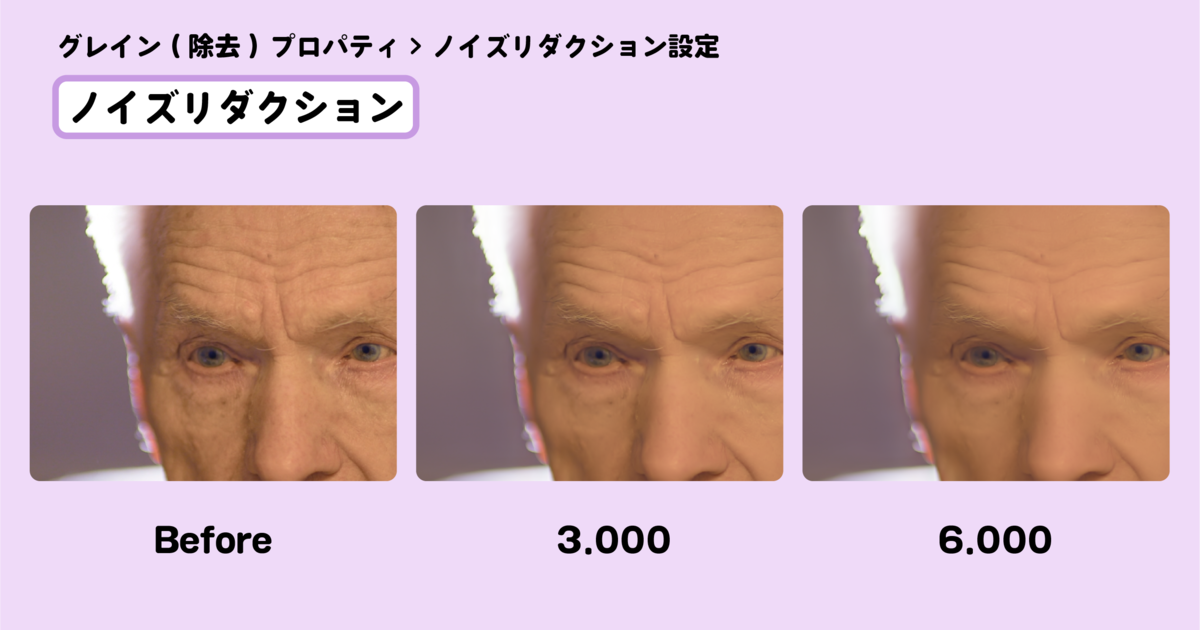
The two original visual references illustrate texture and noise removal. They depict different subjects and are not a controlled before/after experiment; the left image does not establish whether native sensor noise is present.
Part II. Intentionality · 2.1 Shape with directional light
Light does more than make a subject visible: it determines how the audience sees it. I prefer illuminating one side of a subject while retaining shadow on the other.
Discussions of key and fill light by the American Society of Cinematographers offer a technical reference: fill controls how deeply audiences can see into shadows and helps establish mood. [09] Shadow is a controllable expressive variable, not necessarily a defect.
The point is not that every portrait must be half-lit, but that the creator understands direction, contrast and expressive purpose.
Value: creative agency rather than mechanical compliance.

Part III. Restraint · 3.1 Use LUTs with restraint
A look-up table maps colors for technical color-space conversion or creative expression. Its availability does not require imposing a strong style on every image.
I reject aggressive grading as a substitute for content, composition or lighting. Color should help audiences understand the image rather than draw attention to the complexity of post-production.
Personal technical notation: −12 LUTs (software, parameter and unit pending clarification).
Value: having the ability to change something does not require using that ability to its maximum.

3.2 Sound serves the narrative
I want audiences to feel something because they understand the content, not merely because they hear a cue. Background music and auxiliary effects may establish rhythm, reinforce the narrative or direct attention, but should not substitute for substance.
Gain is logarithmic: amplitude ratio A₂/A₁ = 10^(ΔdB/20). Relative to the same initial amplitude, +3 dB increases it by approximately 41.3%, whereas −3 dB decreases it by 29.2%. The operations are reciprocal, but their absolute changes differ. This mathematical relationship is frequency-independent; human perception is not.
Harvey Fletcher and Wilden A. Munson published their research on loudness in 1933. ISO 226:2023 describes equal-loudness contours: different frequencies at the same sound pressure level do not necessarily sound equally loud. [06][07] Modern programme loudness measurement incorporates frequency weighting, such as K-weighting in ITU-R BS.1770. [08]
My initial mixing rule is to reduce the source amplitude of background music and auxiliary effects to between one-third and one-sixth (approximately −9.54 to −15.56 dB), then assess spectrum, perceived loudness and dialogue intelligibility. Music and effects are not inherently high-frequency; materials with pronounced mid-high energy, transients or spectral overlap with dialogue require particular attention to masking. Reduce gain in relevant frequency bands when appropriate, rather than changing pitch; a fixed physical amplitude ratio does not establish a perceived loudness ratio.
Emotion should emerge from content rather than escalating music and effects to create an illusion of importance.
Value: respect the audience's attention and independent judgment.
| Gain | Amplitude | Change |
|---|---|---|
| +6 dB | 199.5% | +99.5% |
| +3 dB | 141.3% | +41.3% |
| 0 dB | 100% | — |
| -3 dB | 70.8% | −29.2% |
| -6 dB | 50.1% | −49.9% |
| -12 dB | 25.1% | −74.9% |
Part IV. Purpose · 4.1 Narrative above chronology
The sequence in which events occur is not necessarily the best sequence for understanding them. Flashbacks and nonlinear storytelling are permitted.
Walter Murch's Rule of Six in In the Blink of an Eye prioritizes emotion, story and rhythm in editing decisions. [05] Formal continuity should not override more important narrative objectives.
Neither flashbacks nor chronological storytelling are inherently superior. Choose the structure that improves understanding. In nonfiction, rearranging presentation must never distort facts, fabricate causality or conceal key evidence.
Value: methods serve purposes; purposes do not justify distortion.
Part V. Sincerity · 5.1 Allow serious things to remain serious
Just Write's 2017 video essay What Writers Should Learn From Wonder Woman discusses bathos: a sudden joke or tonal shift can undermine an established serious, sublime or moving moment. [02]
Humor is not intrinsically wrong, nor is every anticlimax. The question is why a creator should undermine emotion after establishing it through facts, conflict, choices and cost.
The No Man's Land sequence illustrates an action earned by the character's preceding experiences and decisions. The film allows that action to remain serious rather than diminishing its meaning at the crucial moment.
The same principle applies to commercial videos: memorable lines, brand judgments and conclusions should emerge from evidence, conflict, value-chain analysis and revised judgments rather than appearing without justification.
Genuine admiration does not need to be concealed behind a joke.
Value: let serious things remain serious, and great things remain great.
Part VI. Substance · 6.1 Reject fast cutting without narrative justification
Paul Greengrass's influence is not simply handheld photography and rapid editing, but their relationship to character, urgency and narrative rhythm. In a 2007 Post Magazine interview he discussed clarity in fast editing. [03]
When the style was widely imitated, shorter shots, camera shake and rapid cuts could create the appearance of conflict without providing sufficient information. How One Movie Trilogy Ruined Action Films Forever discusses such imitation and misuse; whether this is the exact video I previously watched remains to be confirmed. [04]
The same problem occurs in short-form video. Rapid cuts, animated captions, music and sound effects may maintain attention when content cannot sustain it, but maintaining attention is not equivalent to creating value.
I do not oppose rapid editing or prescribe a minimum shot duration. I oppose cutting without informational gain, emotional justification or narrative purpose. If reducing the cut frequency destroys almost all appeal, the content rather than the editing may need reconsideration.
Value: substance before form, ability before its appearance.
Part VII. Privacy and Trust (proposed)
7.1 Access is not authorization to disclose
Access, possession, use and disclosure are distinct actions. Permission to know or use information in one context does not imply permission to disclose it or use it in another. Helen Nissenbaum's Privacy as Contextual Integrity (2004) concerns appropriate information flows within context. [11] I distinguish four independent authorizations: access, possession, use and disclosure, subject to applicable law.
7.2 Privacy by default
People should not have to continually justify why information should remain private. Absent lawful grounds or explicit permission, protect information by default. Technical feasibility does not justify broader collection, retention or dissemination.
7.3 Data minimization
Information has value but creates management obligations and security risk. Do not collect or retain information merely because it might become useful someday.
7.4 Trust is a long-term asset
Trust takes time to build, and a single decision may destroy it. Evaluate information security and privacy in the context of long-term relationships rather than the benefit of one disclosure. Trust should not be consumed for short-term gain.
This chapter remains proposed; specific personal commitments require confirmation.
Part VIII. The Standards We Maintain
These principles concern imaging, narrative, privacy and information management, but they are not isolated. Authenticity protects detail; agency demands deliberate choices; restraint limits the use of power; purpose governs methods; sincerity protects earned emotion; substance refuses superficial substitutes; privacy limits authorization; trust rejects short-term exploitation.
These standards do not imply that my views will never change. Learning, practice and reflection should correct inaccurate judgments. But revisions should arise from better evidence, understanding and judgment, not because following the standards becomes difficult.
Standards may evolve. They should not be lowered for convenience.
References
- Miss Sloane, John Madden (2016)
- Just Write, What Writers Should Learn From Wonder Woman (2017)
- Paul Greengrass, Director's Chair: Bourne Ultimatum, Post Magazine (2007)
- How One Movie Trilogy Ruined Action Films Forever (2018; candidate source)
- Walter Murch, In the Blink of an Eye (1995)
- Fletcher & Munson, Loudness, Its Definition, Measurement and Calculation (1933)
- ISO 226:2023 — Normal equal-loudness-level contours
- ITU-R BS.1770 — Algorithms to measure audio programme loudness and true-peak audio level
- American Society of Cinematographers, Lighting a Set (technical reference)
- Blackmagic Design, DaVinci Resolve technical documentation
- Helen Nissenbaum, Privacy as Contextual Integrity (2004)
Creative principles and corresponding values
| Creative principle | Corresponding value |
|---|---|
| Preserve native camera noise | Authenticity |
| Directional lighting | Intention |
| Use LUTs with restraint | Restraint |
| Attenuate music and effects | Respect |
| Permit nonlinear storytelling | Purpose |
| Reject gratuitous bathos | Sincerity |
| Reject artificial intensity | Substance |
References and creative influences

What Writers Should Learn From Wonder Woman
Just Write · 2017Reject gratuitous bathos; allow sincerity and serious emotion to stand. The narrative must earn its climax.
Watch original video ↗
The Bourne Series — Paul Greengrass
How One Movie Trilogy Ruined Action Films Forever · 2018Distinguish rapid editing from artificial intensity created by its misuse. This essay is a candidate source; the exact video previously watched remains unconfirmed.
Watch original video ↗Related reference: David Bordwell — Unsteadicam Chronicles ↗
The images are referenced film stills, not verified frame captures from these video essays. Third-party rights remain with their owners.